
Stone of the Month for September 2026: Pinolite from Austria
September is a month of harvest, not only in nature but also within ourselves. It is the time when we gather the fruits of the year, and our work and efforts from the past months become visible. It is also the moment when nature invites us to focus on what truly matters, to slow down, and to reflect.
Pinolite instills patience and balance in us, while also providing strength and energy. With patience and serenity, we can carry out our plans, continue them, and bring them to a successful conclusion. In doing so, pinolite strengthens our mindfulness and clarity, allowing us to act with greater purpose. We can let go of outdated ideas and notions, while common sense and a pragmatic outlook are reinforced.
Mineralogical Profile of Pinolite
It consists mainly of:
- Magnesite (MgCO₃) – Category: Carbonates and Nitrates
- Dolomite (CaMg(CO₃)₂) – Category: Carbonates and nitrates
- Graphite (C) – Category: Elements

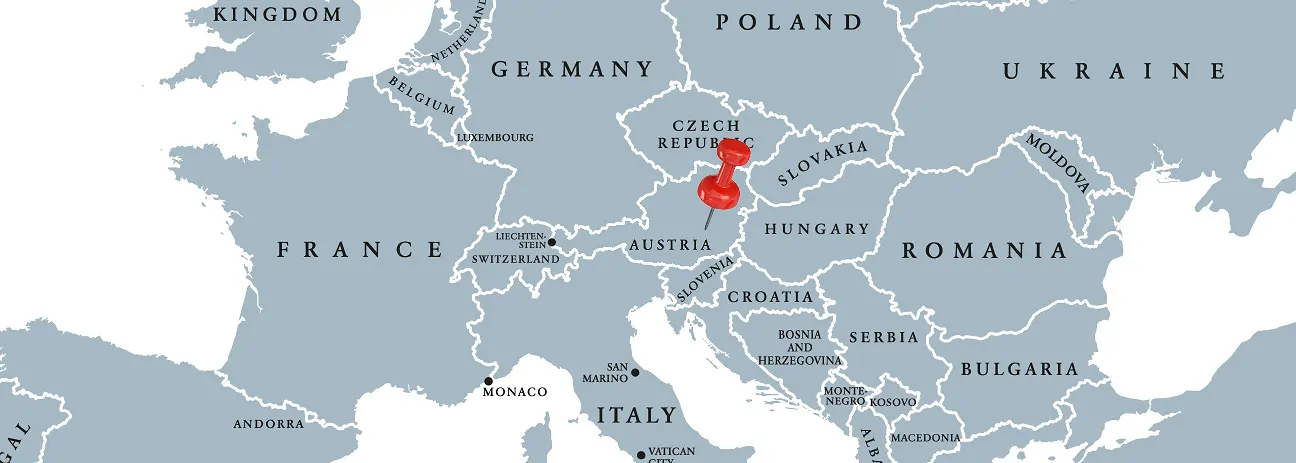
Localities of Pinolite and Main Source Countries
For a long time, pinolite was considered a geological peculiarity of Austria. For about 150 years, it was believed that the rock had only one locality, in the deposit in Styria.
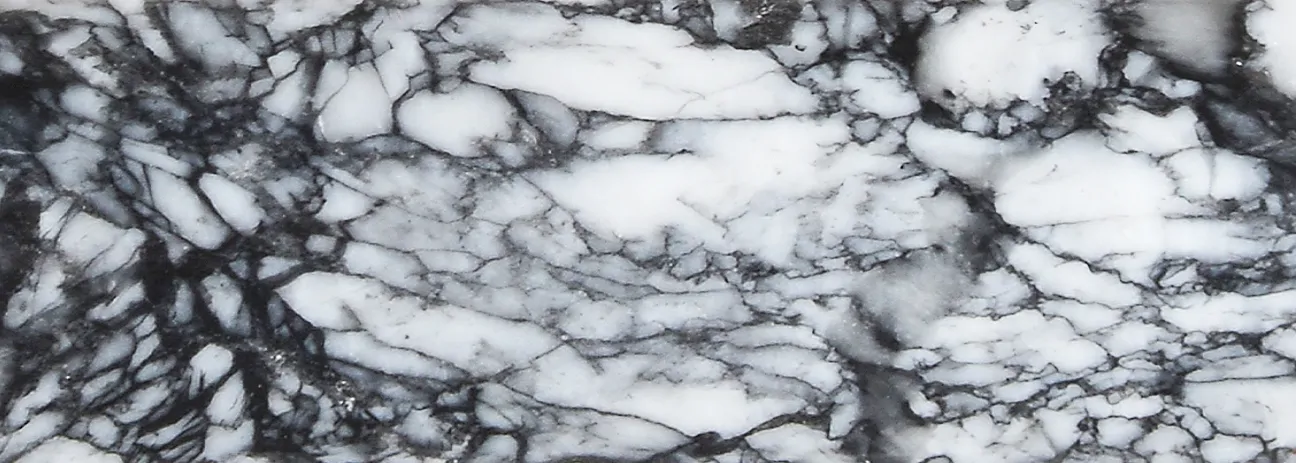
It was not until 2018 that gold prospectors in the mountains of British Columbia (Canada) accidentally discovered another locality. Although the rock formation had already been mentioned in a geological mining report in the mid-1990s, it subsequently fell into obscurity.
The Canadian pinolite differs slightly from its Austrian counterpart: in addition to Magnesite, dolomite, and graphite, it also contains traces of other minerals such as quartz, titanite, Zircon, apatite, and possibly Muscovite. Radiometric analyses suggest that the rock formed about 500 million years ago.
Pinolite – Etymology and Synonyms
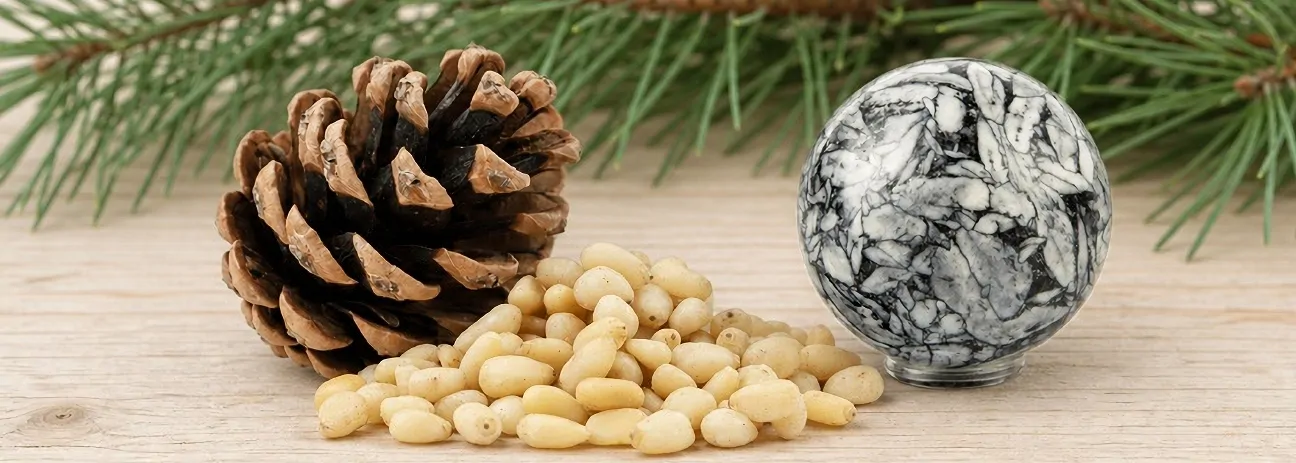
The name “pinolite” describes the rock’s characteristic appearance. The large white magnesite crystals stand out clearly against the dark gray to black bedrock of dolomite and graphite and resemble pine nuts (pinoli). The name is derived from the Latin *pinus* (“pine”) and the Greek *lithos* (“stone”), and thus means “pine stone.”
In German-speaking countries, pinolite is also known as “Eisblumenstein” (ice flower stone) and “Eisblumenmagnesit” (ice flower magnesite). These names refer to the flower- or frost-flower-like patterns created by the formation of the light-colored magnesite crystals within the dark rock matrix. Especially in polished specimens, this structure is reminiscent of the delicate ice flowers that form on windowpanes in winter.

Occasionally, the spellings “Pinolit” or “Pinolite” are also encountered. These are simply alternative spellings of the same rock, not different materials.
“Märbelstein” is a historical Austrian name for pinolite. “Märbel” is an old dialect term for Marble. Due to its decorative black-and-white pattern, pinolite has been used as an ornamental and decorative stone since the 17th century and was traded as “Märbelstein.” It was not until later that the name “pinolite”—which refers to the pine-nut-shaped magnesite crystals—became the standard term in use today.

Historical Use of Pinolite as a Decorative Stone
As early as the first half of the 17th century, pinolite from the Sunk deposit in Styria was prized as a high-quality natural stone under the name “Märbelstein.” Its striking black-and-white pattern made it a sought-after material for sacred and prestigious buildings.
Among its most significant historical uses are:
- Two massive pillars of the high altar in St. Stephen’s Cathedral in Vienna were crafted from pinolite in 1641.
- St. Michael’s Church in Vienna: The sarcophagus and columns of the tomb of Count Johann Baptist Verda von Verdenberg are made of Pinolith.
- Admont Abbey Church: Window and door jambs, as well as numerous architectural elements, were crafted from pinolite, which was known at the time as “Pineolenstein.” Historical sources mention over 1,100 window and door frames made of this material.
- Further examples can be found in the St. Nikolai Parish Church in Rottenmann, the St. Lorenzen Church in the Paltental Valley, and the Hohentauern Mountain Church.
In addition to architecture, pinolite was also used to craft decorative functional objects and works of art. Among other things, vases, bowls, ashtrays, grandfather clocks, sculptures, and sacred art objects were formed from this easily polishable stone. Pinolith’s popularity for decorative polished objects such as spheres and free-form pieces has endured to this day.

Pinolite in the 20th Century
During the 20th century, the magnesite deposit near Sunk in Styria was intensively mined. Mining began at the start of the 20th century and continued—with interruptions—until 1991. During World War II, Magnesite was of great economic importance as a raw material for the production of refractory materials and was therefore mined on a larger scale.
Order donuts, Tumbled Stones, Smooth Stones, and more made from Pinolith at wholesale prices
Pinolith was not specifically mined for this purpose but was obtained as a particularly decorative variety of magnesite rock. Its striking pattern of white magnesite crystals set in dark bedrock made it a sought-after decorative and gemstone. With the closure of the mine, the supply of high-quality Austrian pinolite also decreased significantly, which is why beautiful specimens are comparatively rare today.
After the end of the war, mining continued until 1991. According to estimates, approximately 5.5 million metric tons of magnesite rock were extracted from the deposit between 1904 and 1991. A very small portion of this consisted of decorative pinolite. The majority of this material was mined, making the remaining pieces of pinolite all the more valuable. Since 2013, new owners have resumed operations at the mine, and the extraction of this beautiful stone has continued.
As a relatively new stone in gemstone therapy, comprehensive knowledge about pinolite is not yet available. However, insights can be derived from its mineralogical composition:
Magnesite enhances relaxation and patience and encourages active listening. It fosters a positive self-image while also supporting dedication to tasks at hand.
Dolomite promotes self-actualization. It helps you achieve your goals easily, almost playfully—regardless of whether they are general or personal in nature. Dolomite fosters a contented, optimistic outlook on life.
In crystal healing, pinolite is therefore valued as a stone of calm, serenity, and inner balance. As a meditation stone or during periods of intentional rest, it helps you turn your attention inward, gain distance from the hustle and bustle of everyday life, and find new clarity.
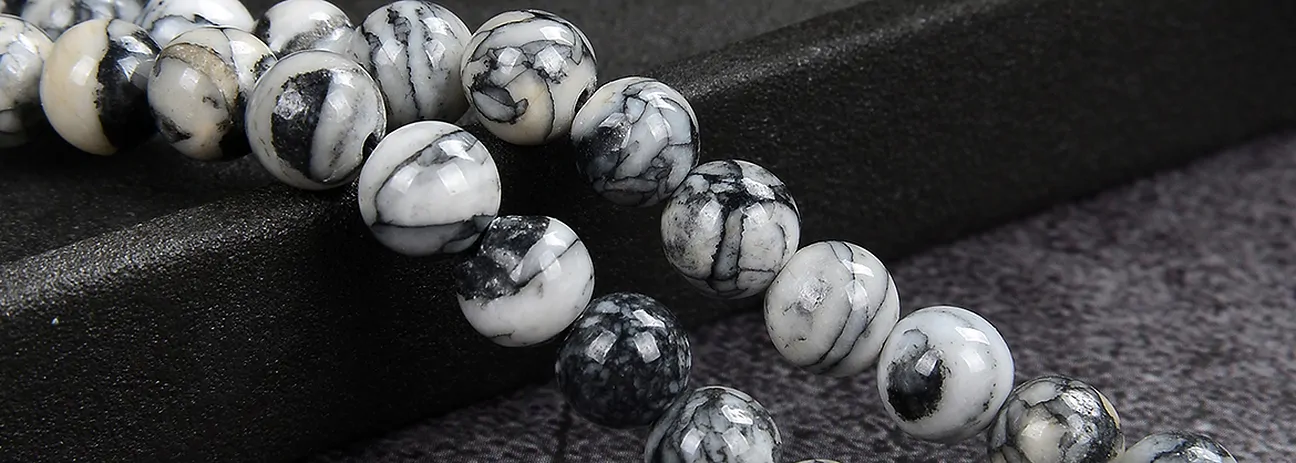
Small Palmstones, strands of beads, and more pinolite items at wholesale prices
Formation of Pinolite
Pinolite forms deep within the Earth through metamorphism—the transformation of existing rocks under high pressure and elevated temperatures. The source material consists of magnesium-rich carbonate rocks that were deposited in a shallow sea approximately 500 million years ago.
During the formation of the Alps, these sediments were transformed over millions of years. In the process, large, white Magnesite crystals crystallized within a fine-grained bedrock composed of dolomite and graphite. The elongated Magnesite crystals grew preferentially in one direction, giving them their characteristic shape, which resembles pine nuts.
The graphite gives the rock matrix its dark gray to black color and creates a striking contrast with the light-colored Magnesite crystals. Since its formation requires very specific geological conditions, pinolite is found at only a few localities worldwide.